
King County Most Wanted: Official Result
Here is the plain truth. The King County Sheriff's Office keeps no verified public most-wanted roster, no lineup of names and faces, no reward offers, and no weekly feature cycle. What it does maintain is the Criminal Warrants Unit page, a working office resource. That unit carries real duties: Superior Court felony and civil arrest warrants, felony arraignment attendance, transportation, cooperative prisoner transfers, and extradition. That gap tempts some sites to invent a wanted list or borrow old photos. Resist it. A historical listing or a news story cannot confirm an active warrant, because court records change and warrants get recalled. Official verification protects everyone involved, from the person searching to the person named. The screenshot people keep sharing points to the official KCSO warrant infrastructure, not to any photo lineup.
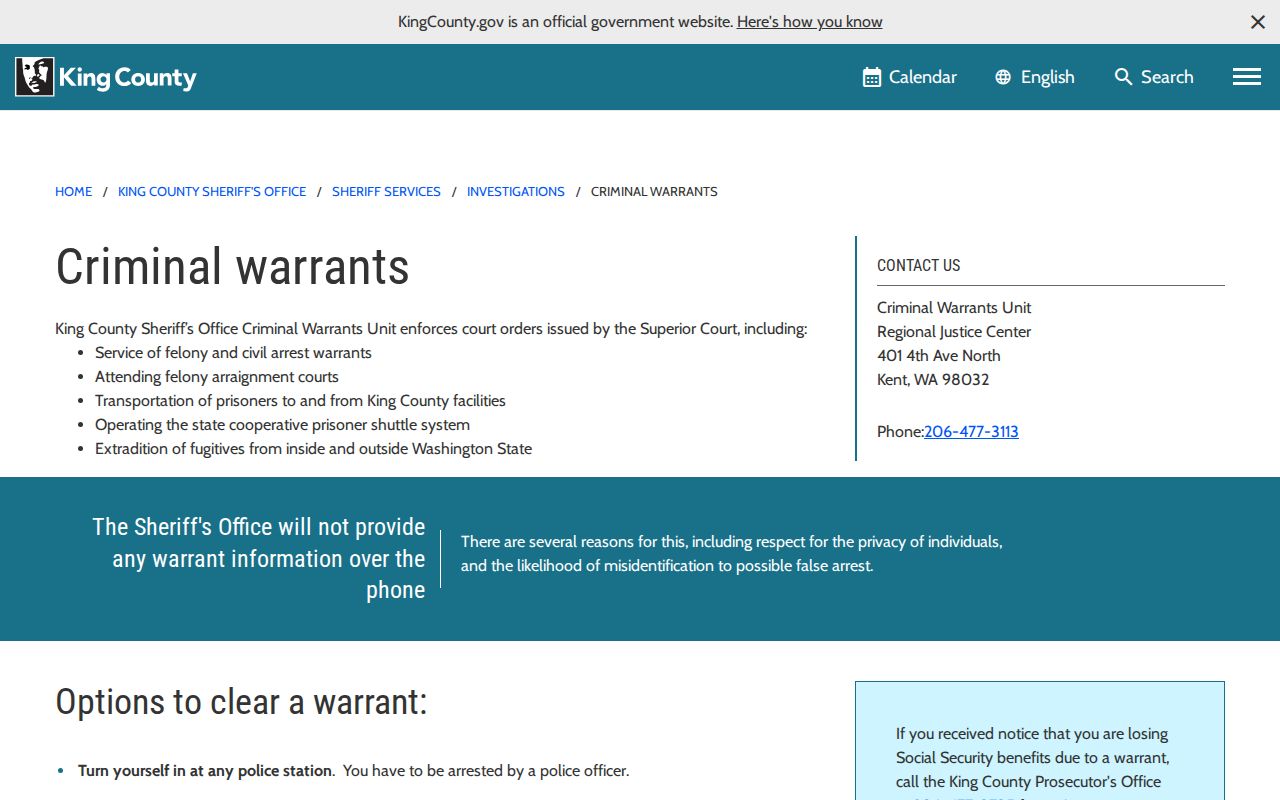
Think of that page as a front desk, not a gallery wall. It routes court-specific questions and takes tips safely. Nothing there should be relabeled as a live King County Most Wanted display.
King County Warrant Types and Courts
Start with the issuing court, because that determines your best contact. Municipal charges? Call the relevant municipal court. Misdemeanor matters from unincorporated King County generally go to District Court, while felonies land in Superior Court. A booking search sits in a different lane entirely, since custody records and case status are separate things.
| Type of question | Official route |
|---|---|
| District Court warrant | District Court case access, a court location, or the court’s telephone route. |
| Superior Court felony or civil arrest warrant | KCSO Criminal Warrants Unit and Superior Court case or counsel route. |
| Municipal charge | The municipal court for the city involved. |
| Current adult jail custody | DAJD Subject Lookup, which is not a warrant database. |
| Later outcome | The court case, docket, and disposition record. |
A bench warrant is a court-issued order, usually tied to a missed required appearance. An arrest warrant is court process too. Neither invites the public to investigate or take action. Worried about your own status? Counsel and the issuing court are the safe paths. Verification belongs to the court, not to a news clip or a secondary index.
How to Check a King County Warrant
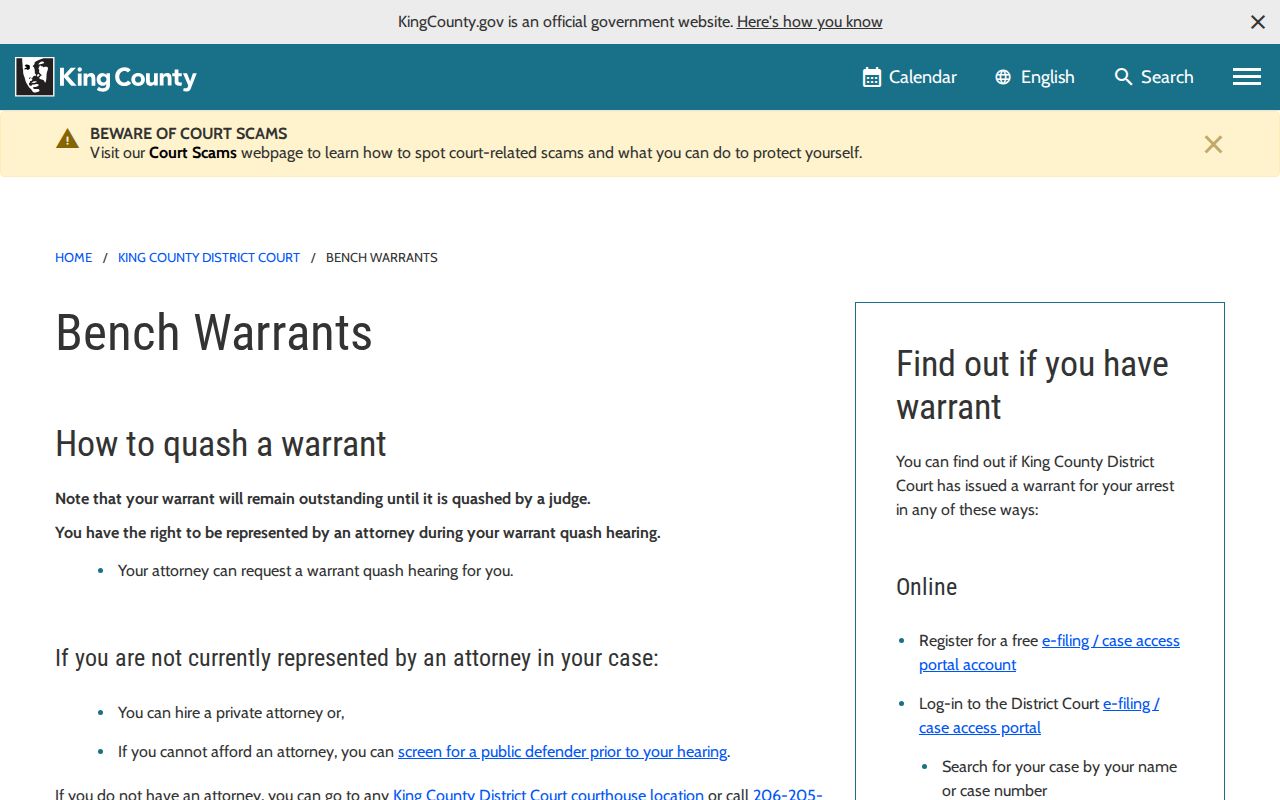
King County District Court offers a direct official route for its own matters. The warrant information page lays out three options: create a free e-filing and case-access account to search by name or case number, visit a District Court location, or call 206-205-9200. This channel exists for proper verification. It was never meant as a casual person-finder.
- Identify the court named on the case or the jurisdiction of the charge. Do not infer it from a news report alone.
- For a District Court issue, use the official case-access account, visit a court location, or use the court’s published phone route.
- For a municipal or Superior Court matter, contact that court or seek advice from counsel. KCSO provides court-specific direction through its warrant unit.
- Read the current court information before making a decision. A court may provide a warrant-quash process through counsel or, in limited settings, the clerk.
- Resolve the matter through the court and attorney process. Do not attempt to hide, evade, approach, follow, or detain anyone.
A jail roster helps once someone is already in DAJD custody. It won't say whether a warrant is active or resolved, though. For adult custody and booking records, use the King County records lookup.
What a King County Warrant Notice Can Show
Don't expect a neat set of fields. The KCSO page verifies no listing format, so inventing a photo, reward amount, caution flag, or last-known location would just be fiction. An authentic court notice can identify case information, but check the source and its date before trusting anything. The right question is simple: does the official court route confirm an active matter? A polished-looking profile elsewhere proves nothing.
| Reliable item | Why it matters |
|---|---|
| Court and case number | Connects a question to the office that can verify it. |
| Person’s legal identity details | Helps avoid confusing people with similar names. |
| Current court status | Shows whether a court has a live procedural record. |
| Agency contact | Gives a safe place to send information or ask a case-routing question. |
| Disposition or court action | Supplies the context a booking or initial notice cannot provide. |
Photos on any official fugitive notice stay with the agency that issued them. KCSO has supplied no public wanted-photo roster to reproduce here. Federal fugitive pages have their own jurisdiction and never substitute for a local warrant check.
King County Warrant Tips and Safety
Got information? Send it to the Criminal Warrants Unit at KCSOWarrantsTips@kingcounty.gov. Tips can be anonymous, though the unit asks for the person's name and date of birth, plus any context you can add. This channel exists for passing information to law enforcement. It is not a license to contact the person named.
Safety note: Never approach, confront, follow, or try to detain someone you believe is wanted. Report immediate danger to emergency services and send anything less urgent to the responsible agency.
No reward program exists here, so none gets claimed. KCSO's page establishes neither a current reward nor a Crime Stoppers offer for this purpose. A warrant is court procedure, nothing more. Public safety is best served by reporting what you know safely and letting trained officers handle the enforcement.
King County Booking Records After an Arrest
Start with custody. If someone lands in DAJD adult custody, the Subject Lookup tool can tell you which facility holds them, which agency made the arrest, and the booking number and date. It has limits, though. No booking photo appears there. A person who has been released or moved to another facility may vanish from the current search without explanation. DAJD itself describes its historical booking data as an event dataset, so treat it as a custody log rather than a court record.
Once you have a custody result, take it to the courts. King County District Court case access lists hearing dates, judgment details, sentence conditions, and warrant status within its own access rules. Superior Court keeps a separate portal for its records. The order matters: run the warrant check first, add the custody result if it applies, then read the court file for what actually happened next.
The official District Court warrant instructions appear in the image supplied here. They draw a clean line between what a court verifies and what a public wanted list can tell you.
A booking charge is only the start of the story. It may be reduced or dropped. It may get worked out in a plea. Or it can sit unresolved for months. The court record is what settles the question in the end.
King County Court Status After a Warrant
A warrant question rarely ends with one search. District Court case access can reveal hearing dates, judgment information, sentence conditions, warrant status, protection order status, and an index of filed documents, though registration is required and some documents carry their own rules. Superior Court runs on the KC Script Portal with its own public-record process. Municipal cases stay with the city courts that issued them.
Timing helps set expectations. King County Superior Court normally holds arraignment within three days of filing for a detained person or someone released with conditions, while other matters follow a different schedule. The arraignment is an early step, not an outcome. A plea and conditions get addressed there. From that point the case can move toward dismissal, diversion, a plea deal, trial, or sentencing, and no roster or news article can tell you which way it went.
Tips and court matters are separate lanes. A sighting belongs with law enforcement. A person actually living under a warrant should contact the issuing court or a lawyer instead. Keep in mind that some court records are sealed or restricted, and those limits deserve respect rather than a hunt for a workaround.